Maryburgh Past Industries

Attribution: S. Fraser (Maryburgh Primary School March 2015)

Ussie Mill

This Corn and Meal mill was in operation during the second half of the 18th century.

This Corn and Meal mill was in operation during the second half of the 18th century.

Attribution: unknown

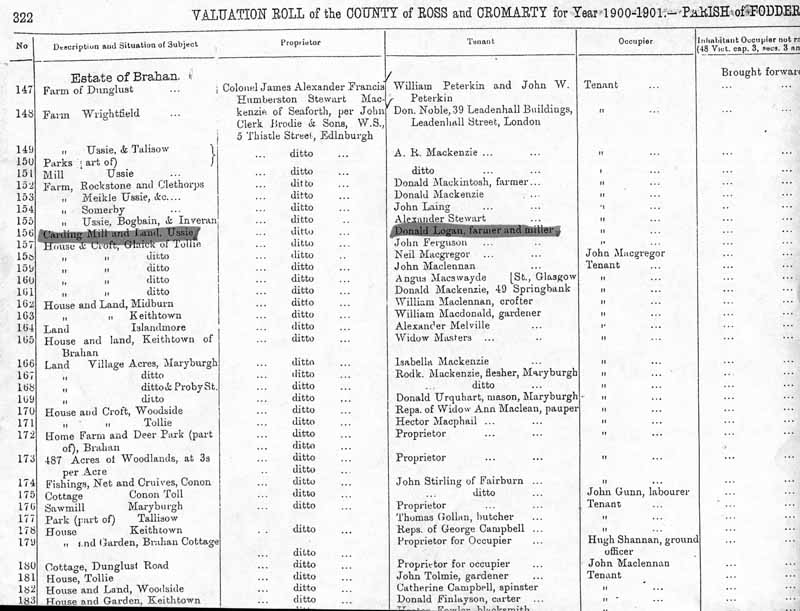
CARDEN MILL

The CARDEN MILL is possibly of the same period as the USSIE MILL but, although the lade can be identified, only the outline ruins of the building foundation can be seen.

The Fodderty Parish Valuation Roll with the Carden Mill and Land listed

Attribution: unknown

Snuff and Lint Mill

The location of the SNUFF and LINT MILL is shown on an ESTATE MAP dated 1787, but there is no evidence to be seen of its exact location today.

The location of the SNUFF and LINT MILL is shown on an ESTATE MAP dated 1787

Attribution: unknown

Brick and Tile Works

On a later map, dated 1847, a brick and tile works is shown as being in production on a site immediately below the old road bridge at the north-east end of the village and probably continued in operation to a much later date. In fact, the modernisation of some old properties in Maryburgh has revealed the use of MARYBURGH BRICKS.

Maryburgh bricks used in construction of old properties in Maryburgh

Attribution: unknown

View more photos relating to past industries

Click on photo album to view thumbnails and then click thumbnail to see the full size images 
Maryburgh » Maryburgh History » Maryburgh Brahan Castle
Brahan Castle
Brahan Castle
Another view of Brahan Castle. [Photo courtesy of Mavor Wilson.]
Brahan Castle
Brahan Castle
Brahan Castle
Brahan Castle
Photograph donated by Mrs Rosemary Henderson, Maryburgh. Note the two stags at the front of the Castle.
Ornamental Stags
Ornamental Stags
Dingwall Volunteers Band
Dingwall Volunteers Band at front of Brahan Castle, date unknown. [Photo courtesy of Lewis Mackenzie.]
Old Colours of Seaforth
Old Colours of Seaforth. (The small boy on the left is Jimmy Wilson, son of the Estate Factor.)
Built in the early 17th century, it was a stronghold of the MacKenzies
Due to the exorbitant costs of upgrading, Brahan Castle was dismantled in 1953. Built in the early 17th century, it was a stronghold of the MacKenzies.
The Entrance to the Castle
[W J MacCulloch collection]
Ornamental Stags
Ornamental Stags
A fine pair of ornamental stags once surmounted the sturdy pillars either side of the drive leading to Brahan Castle, c.1903. (See "Manderley", Strathpeffer.)
Ornamental Stags
Ornamental Stags
A fine pair of ornamental stags once surmounted the sturdy pillars either side of the drive leading to Brahan Castle, c.1903. (See "Manderley", Strathpeffer.)
Main hall
Main hall
The Golden Bed
The Golden Bed
Sittingroom/Study
Sittingroom/Study
Main hall
Main hall
Music room
Music room
Music room
Music room
Main hall
Main hall
Billiards room
Billiards room
Main hall
Main hall
Mackenzie tartan
Mackenzie tartan
Plaque beside the golden bed.
Plaque beside the bed. The caption reads as follows: "History of the Golden Bed of Brahan. "Colonel Daniel Mackenzie was for some time in the service of Colin Earl of Seaforth and afterwards, going abroad, served in the wars for several years in Moscow and Flanders. "There, having by his merit and valour run through the inferior degrees of honour, he at length attained that of a Colonel of a Regiment of Foot and married the daughter of Dean Wolfard, Count de Vredrad, Governor of Buldorbe in Flanders, a descendant of the noble and illustrious House of Nassau."
The site of Brahan Castle viewed from the old stable buildings.
(Photo taken on an 'Open Day' 2000.)

Please submit your comment

Do you have any more information about any of the content on this page.

Your comments are always welcome: