
River Conon Flooding
Attribution: S. Fraser (Maryburgh Primary School March 2015)
The Conon River Flooding
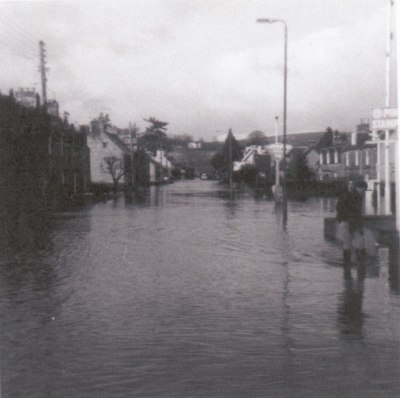
On a Saturday afternoon in December 1966, the local Girl Guides’ Christmas Party was in full swing, when to everyone’s utter amazement, a voice advised that everyone should prepare to go home because the River Conon had burst its banks and the lower part of the village was being flooded.
Coming from the School Road Church Hall (which has since been renovated and converted to a beautiful home) an ominous, chilling, dull roar from a distance met our ears. The children from the party were sheparded safely home, and curiosity drew the adults to the low-lying section of the village. By this time the flood water had reached Riverbank Road, was surrounding the Church and encroaching onto the car-park. A feeling of great disbelief coincided with the scene that met our eyes.
Where possible, those whose homes were threatened by the incoming flood water quickly moved their belongings to a safe level, but unfortunately, there were a number of bungalows in this part of the village whose owners lost everything. Families from the single storey houses were evacuated to the school canteen where they had heat and food available, and a place to sleep. Many people chose to stay in their homes, and as the flood water rose inside their homes, they moved upstairs for the night. For these people, sustenance was delivered through an upstairs window from the “delivery van” – the front bucket of a JCB.
First aid services sprang into action with no-one who was stranded or marooned lacking accommodation, food or warmth, despite the sudden unexpectedness of the situation. Several of the flood victims were looked after by private individuals in the village during the flood, and in some cases, for some time afterwards. Kindness and consideration certainly took over at this time.
As the flood water receded, farmers from around the area donated grain-drying equipment in an attempt to dry out houses and contents. The major tasks of cleaning affected houses went on for what seemed months, as people slowly but surely worked through their damaged belongings in an effort to determine what could be salvaged. In some cases, this was very little. Over the next few months after the flood, the village pulled together with huge amount of time, effort and substance put out in their endeavour to help the affected villagers.
As previously mentioned, the JCB bucket carried nourishment to families on the night of the flood, but that same bucket had an even more precious cargo on-board during that eventful night. Many of the older members of the village will remember with great affection, a very gracious lady, the late Miss Bella Mackenzie, who, at a very advanced age, was particularly remembered for cycling on a near daily basis in and out of Dingwall, and was one of the householders who decided to “stay put, upstairs”. But the “boys” who were supervising the situation did their level best to persuade Bella to “come down”. Unfortunately, downstairs had 3-4 feet of freezing cold, dirty, muddy water swirling about. So how was Bella’s rescue to be implemented. Yes, you’ve got it, the JCB bucket. The only problem was that this had to be carried out on Bella’s terms. All the men around the machine had to turn their backs to the digger and look in the opposite direction as Bella stepped into the bucket. Modesty, even in adversity, ruled the day.
Over the following weeks, teams of ladies assumed the role of “charladies” sorting out clothes for laundry, and scrubbing out the houses, which when the water finally disappeared, left a thin, very stubborn film of silt over everything. One memorable aftermath was the sight, at Marybank, of turnips lodged 15-20 feet up in the branches of riverside trees, looking like some exotic fruit waiting to be harvested. Once the mess caused by the flood was dealt with, a committee was formed which considered all the steps deemed necessary to ensure no recurrence of a similar disaster in the village any time in the future. The Hydro-Electric company have since installed computer-linked monitoring stations along the Conon valley, and also on the other rivers linking into the scheme which has been very effective in controlling the water levels, particularly through some very extreme weather conditions in the area over the last 15 years.

The flooded River Conon in 1967, sweeping across the road leading from Moy Bridge to Marybank, upstream of Maryburgh and Conon.
Attribution: unknown

Attribution: unknown

Attribution: unknown
WORST IN 100 YEARS - SEA OF DEVASTATION
Extract from the Scottish Daily Express – Monday 19 December 1966
WORST IN 100 YEARS
SEA OF DEVASTATION
A SEA of devastation swept through the Highlands last night. In the worst floods in memory, hundreds of families had to quit their homes, bridges were swept away, and miles of countryside were under water.And last night the Ross-shire village of Conon Bridge was declared an emergency zone after a great “tidal wave” tore through the main street. More than half the houses in the village (pop. 700) were inundated by the swirling torrent. Fences and walls collapsed. In some downstairs rooms the water reached a depth of FIVE FEET – and it was still rising in places tonight.
Squads of police, soldiers, Civil Defence workers and nurses rushed in to help. Centre of rescue operations was the village school were 150 meals were served to volunteers who toiled through the night and day. As full-scale evacuation swung into action, one man said “It will take us days to assess the damage. But it must be colossal.” Before telephoning this dispatch ( saysNinian Reid) I had to wade knee-deep through mud and water. And I have just heard people cheer the first vehicle to use the road since 6ft deep torrents roared through the streets at midnight. The car battled through the swirling current.
Terror hit the village which lies in a dip near the swollen River Conon. On the spot throughout the long, hard night was the minister, the Rev. D R. McLeod, whose church was closed yesterday as water and mud spilled in. He comforted throngs of people milling about in their nightclothes. At the height of the drama baby Alan Kelman – 10 days old – was gently lowered to safety from an upstairs bedroom window. This was at 3 a.m. His father, Mr Morris Kelman (30), his wife Kathie and their three-year-old daughter Moira were saved by rescuers using ladders attached to a lorry. Said Mr Kelman: “Thank God the baby is all right. You read about this sort of thing happening in the north of Italy. You never expect it to happen on your own doorstep. People say they are the worst floods for over 100 years.”
Water poured in through the foundations of a house occupied by invalid Mrs Joey Maclennan and she had to be carried to safety. Shopkeeper Mr John Mathieson (40), a father of two, admitted: “I was up to my waist in water in a desperate bid to salvage some of my belongings. But it was a hopeless battle.” All day long a shuttle service of bulldozers, pick-up trucks and Army lorries ferried people from their stricken homes. Most of them were taken to a local hotel and neighbours looked after the rest. The village football pitch was 6ft deep in water. Miss Jessie Fraser (50) refused to leave her home in Main Street. The minister helped her take some belongings to an upstairs room. She said: “The water was swirling above my waist. It swept suddenly across the road.”
Food was “dropped” into houses by ladder last night as men waded about in their downstairs rooms trying to save belongings. Sandbags already submerged by the floodwater, were piled up against front doors as the people waited for high tide. Five miles down the road at Beauly, a caravan site was washed away when the river burst its banks. But the people escaped. Some were neck-deep in water. Others were rescued from their homes by boat. A two-year-old £70,000 bridge at nearby Kilmorack was in danger of collapsing. It was badly damaged when hundreds of tons of rubble crashed down on it.
Ross was the worst hit county (telephones ALEX McEWEN) with floods paralysing the East and cutting off the West. At Achnashellach, halfway between Garve and Achnasheen a landslide swept down on the home of forestry worker George Robertson. He and his wife Katie with four of their six children, dashed out into the lashing rain to safety. On the road to Skye, between Clunie and Kintail, two bridges were swept away. Two workmen, in a heavy lorry were swept off the road and the vehicle landed upside down on the moor below. Hundreds of sheep and about 20 cattle were drowned. INVERNESS-SHIRE roads surveyer, Mr David Hamilton, said last night: “None of my men can remember such long and sustained flooding from the River Beauly to the Spey.” They will work throughout the night to open the main roads and, failing that, the alternative roads. “Many roads are blocked. The main road between Inverness and Dingwall is open but is still under 18 inches of water.”
Attribution: unknown

Attribution: unknown

Attribution: unknown
Aviemore, the new winter holiday resort suffered the worst floods in the Cairngorms. The Spey was a quarter of a mile wide. Caravans were washed out and some knocked over by the floodwater. Skiers could not get through to the ski road. “Plenty of snow up there,” said an instructor “but no way of getting there.” A large part of Speyside is a vast swamp. Hundreds of acres were flooded. Sheep and cattle are marooned and the raging floodwater running over 10ft high in parts threatens to cut off isolated homesteads. TheA9 Perth-Inverness road was deeply flooded between Kingussie and Aviemore. Many lorries and cars were stranded last night. The Perth-Inverness railway track was just visible above the water. Houses at Lynchat on the A9 were flooded and people were evacuated from three houses by Spey Bridge at Aviemore. At Fort William, 100 men had to be evacuated from the British Aluminium factory hostel to a local drill hall after the River Nevis overflowed. Kinlochleven had six inches of rain in 24 hours. Rivers ran alarming high and drains unable to cope with the water had streets awash and gardens under water. A mile from Kinlochleven at Narroch Bridge a waterfall cascaded across the road and four miles further along heavy boulders washed down the mountainside, blocked the road and halted traffic.
A landslide at Achnmashellach Station on the main line from Dingwall toKyle of Lochalsh on Saturday night blocked 60 yards of the track. 40 passengers were put up at an hotel. Last night a minibus was to take them to their destinations. Golspie’s Main Street, which is on the trunk road to Wick, was flooded for the second time within a fortnight. For three hours fire engines pumped the water into the sea and saved two houses from a second flooding.
View The River Conon Flooding Photos
Click on photo album to view thumbnails and then click thumbnail to see the full size images


