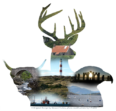
Attribution: Collage by Siobhan Fraser 

Rosehaugh Estate

Rosehaugh Estate

This is one of the few remaining buildings on the Rosehaugh Estate of the grand buildings commissioned by James Douglas Fletcher. As its name implies it was the dairy to the ‘big house’. Run independently of the Mains Farm, a pedigree herd of Jersey cows provided milk, butter and cheese to the house. During the war the dairy also supplied milk to the village.

Dairy Cottage

Dairy Cottage

Since the 14th century there has been an estate just west of the village of Avoch. Formerly known as Pittanochtie, the estate was owned by Mackenzies but when James Fletcher bought it in 1864 it was known as Rosehaugh. James made some alterations to the building with assistance of architect, Alexander Ross. Upon James’s death in 1884, his son, James Douglas Fletcher made further alterations with the assistance of architect, William Flockhart, who created a magnificent structure which was unfortunately demolished in 1959. Only some of the estate buildings are left such as the stables shown here which now acts as the estate office for the present owners Broadland Properties Ltd.

James Douglas Fletcher

Painting of James Douglas Fletcher, the son of James Fletcher who inherited Rosehaugh House.

Attribution: Photo is courtesy of Lodge Rosehaugh, Avoch.

Although this mansion stood for only 60 years the estate had always provided employment for the village and the Fletchers in particular did much to improve conditions in Avoch. These pages give a glimpse of this magnificent house. For a much more comprehensive view see the book “Rosehaugh, A House Of Its Time” published by Avoch Heritage Association.

In December 2016 a new edition of the book “Rosehaugh: A House of its Time” was launched on the 20th anniversary of its first edition. Co-written by Hilda Hesling, Magdalene Maclean, Kathleen Macleman and the late John Mills, the book contains new material and photographs and is available from Bassman Books. www.bassmanbooks.co.uk

Click on the link below for more in depth information

Click on photo album to view thumbnails and then click thumbnail to see the full size images 
Avoch » Avoch History » Avoch History Introduction
Boats on burn
Boats on burn
Boats used to be dragged up the burn under the Henrietta Bridge. The two nearest boats pictured here are the "Honour Bright", owned by Alexander Macintosh, and the "Alison Ann" which was nicknamed "The Tank".
Mrs Jeannie Reid
Mrs Jeannie Reid
Whilst their menfolk went to the fishing, their women had to work hard. In addition to bringing up a large family, Mrs Reid would carry fish around the area in the basket called a "murlach". The contents would be exchanged for oatmeal or vegetables. Similar baskets could also be used for carrying firewood
Fountains on Burn
Fountains on Burn
For a short time the burn sported fountains. The blanket factory may be seen in the background. The weir can still be seen from Long Road.
Harbour
Harbour
The old entrance to the harbour can be seen in the centre of the picture. After World War 2 it was changed to the East side. The steps shown here can no longer be seen as the harbour wall now adjoins the road at this point. The boat leaving the harbour is a Scaffie Yawl.
The Helmsdale
The Helmsdale
This boat was a regular visitor to the harbour where it discharged coal. John Clark and his brothers sold the coal from lorries around the village and surrounding areas.
Bridge Street
Bridge Street
Looking West from the Lazy Corner, the buildings on the left are the Old Post Office and the Station Hotel. The hotel was owned by Kenny Maclean and his sisters and for many years it was always referred to as "Kenny's".
High Street
High Street
Looking West again, the Central Hotel can be seen after the openings to Alexander St. and John St. The thatched houses on the right stood where the car park for the hotel is now. A water pump may be seen outside one of them.
Central Hotel
Central Hotel
This building, known as "Cruikies" after the owners, Cruikshanks. It later became the Harbour Inn then ceased functioning as a pub and was called th 'Bite and Blether'. It is presently used as a residential driving school.
Lazy Corner
Lazy Corner
Looking down the brae from the upper part of the village the white building is the site of the Mace Store on the corner of George Street. This part of the road has been widened and a separate, raised footpath now exists on the left.
Old Meal Mill
Old Meal Mill
It is difficult to visualise where this mill stood as the road has changed but the old Mackenzie School may be seen on the extreme right of the picture and the east end of Mackenzie Place. Knockmuir Farm is just visible on top of the hill. The Community Centre and Primary School now occupy the land in the foreground of the picture.
Mill Wheel
Mill Wheel
The mill was pulled down around the 1950's.
Mending and Drying Nets
This photograph was taken in the area known as 'Dock' and the houses still stand but the land is now enclosed as gardens for the houses.
Early School Picture
This photograph was probably taken in the early 1900's. Back Row (L to R) W. Whyte, J. Macleay, G. Mackenzie, K. Cummings, H. Reid, W. Macleman, D. Patience, W. Mann, D. Macleman, W. Noble, Miss Mackay, J. Skinner. Middle Row L. Bryson, G. Whyte, M. Patience, J. Reid, N. Ma ?, M. Allison, C. Macleman, C.A. Macleman, C. Ross, J. Sutherland, J. Jack. Front Row G. Patience, R. Jack, W. Reid, G. Patience, W. Jack, A. Ross, D. Sutherland, A. Sutherland, D. MacLeod, W. Macleman.
Station
Station
Until the Beeching era many Black Isle folk used the train to get to Dingwall or, by changing at Muir of Ord, to Inverness. The station building is now a private house.
Tower House
Tower House
After the disruption of the Church of Scotland in 1843, it was several years before a Free Church was established in Avoch. Sir James Mackenzie of Scatwell refused to grant them a site but John Matheson of Bennetsfield donated this spot at the approach to the village. The building was designed by the architect of Inverness Cathedral, Alexander Ross, and was opened in 1897. In 1929 the church was amalgamated with the Church of Scotland and the building became the village hall for several years. In 1986 it was bought and converted to a private residence. Presently part is being used for a local business whilst the east end is a domestic dwelling place.
Travellers
Travellers
In earlier days the travelling folk were regular visitors to the area. Here we see an early car and the older mode of transport. There are many villagers who remember the travelling people camping at the west end of the village in the area of the present industrial site.
Travellers' camp
Travellers' camp
There are many villagers who remember the travelling people camping at the west end of the village in the area of the present industrial site.
Avoch from the West
Avoch from the West
Avoch postcard
Avoch postcard
dividing the spoil
dividing the spoil
View from the beach between the wars
harbour 1926
harbour 1926
high street
high street
old fisher woman
old fisher woman
picnic 1920's
picnic 1920's
view from braehead
view from braehead
Yolley
Yolley
zulu
zulu
Page updated on 11 October 2022

Please submit your comment

Do you have any more information about any of the content on this page.

Your comments are always welcome: